Washington Financial Literacy Standards and Policy Ranking

The Washington Financial Educators Council (WAFEC) is the state advocacy chapter of the National Financial Educators Council (NFEC). Our role is to advance policy, standards alignment, and statewide action to ensure that Washington students graduate prepared to manage real-world financial decisions.

The NFEC conducts national research and develops academic standards. WAFEC translates that research into policy advocacy specific to Washington. Our shared mission is to ensure that all learners graduate prepared to navigate real-world financial decisions by elevating financial education to the same level of quality, accountability, and instructional integrity as other required core academic subjects.
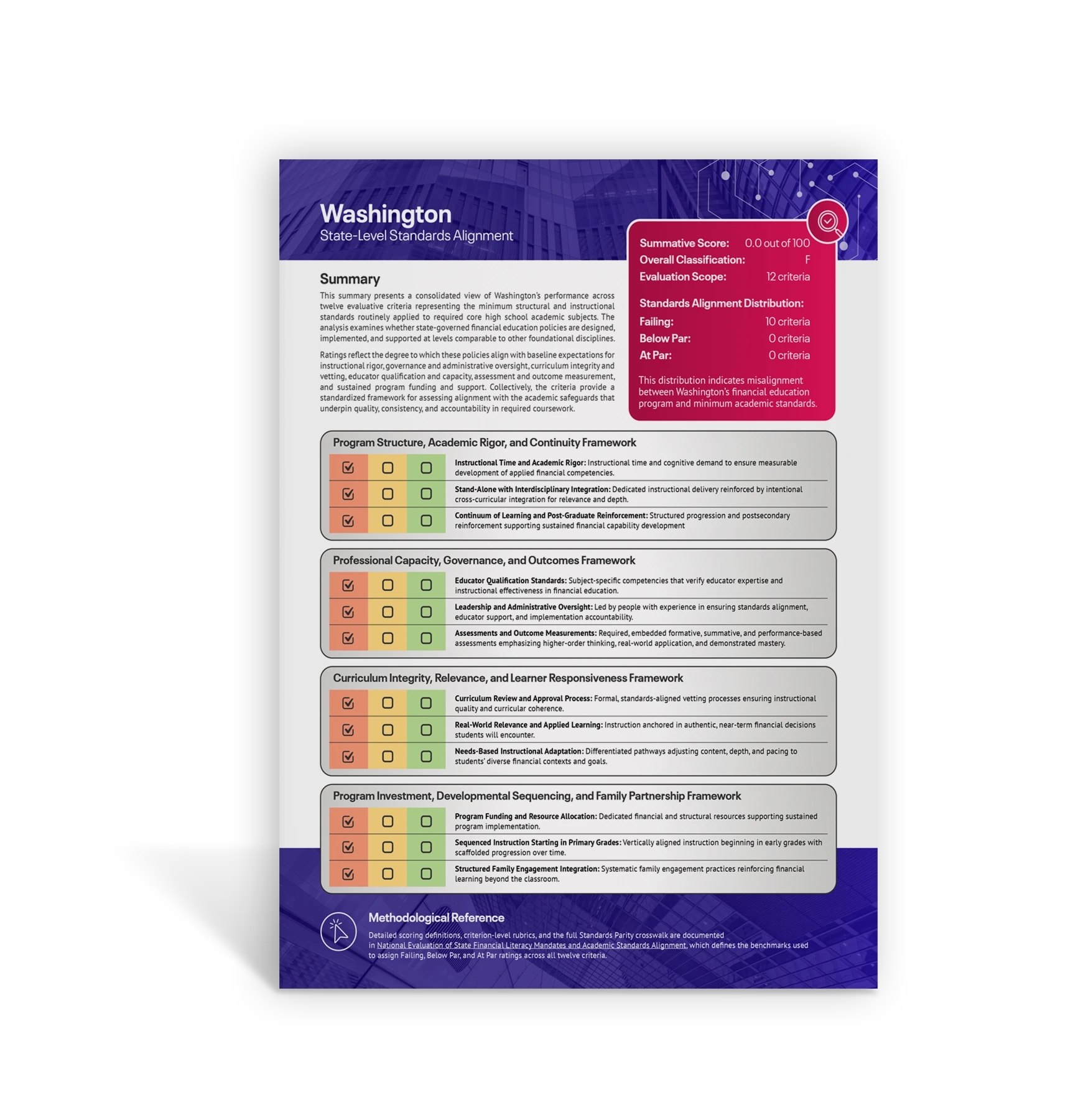
Washington Financial Education Standards Alignment: A State-Level Policy Assessment

The National Financial Educators Council (NFEC) conducted this analysis to create a clear, standardized framework for strengthening financial literacy requirements nationwide. They applied a consistent 12-criterion frame to compare each of the 50 states in terms of financial education rigor, governance, curriculum selection, educator preparedness, assessments, and long-term program support. In the case of Washington, the findings highlight a significant opportunity for policymakers, educators, and key stakeholders to improve both the design and rigor of financial education initiatives. Enhancing these components would better equip students with the real-world financial knowledge and decision-making skills necessary to promote lasting financial stability and informed economic behavior.

Results from the Washington analysis reveal a pronounced gap between the state’s current financial literacy instruction and the benchmarks typically expected of core academic subjects such as mathematics, English/language arts, and science. Washington earned an overall alignment score of 0.0 out of 100, receiving a classification of “Failing.” Each of the 12 evaluation criteria was rated as failing, with no areas achieving partial or full alignment. This outcome suggests a clear departure from recognized best practices and underscores potential weaknesses in curriculum quality, implementation, and statewide policy infrastructure.

Washington Financial Education Assessment

WAFEC’s Advocacy Focus in Washington

WAFEC works to ensure that financial education is treated as a core academic subject rather than optional enrichment. Our advocacy is organized to advance priorities that align Washington’s policy environment with established academic expectations.
Research & Policy Guidance

WAFEC promotes financial education policies aligned with core academic standards, emphasizing clear outcomes, educator preparedness, and accountability. Grounded in national research, WAFEC works with educators, community leaders, and policymakers to identify gaps, evaluate legislation, and support scalable, standards-aligned implementation.

Standards for Financial Educators and Learners

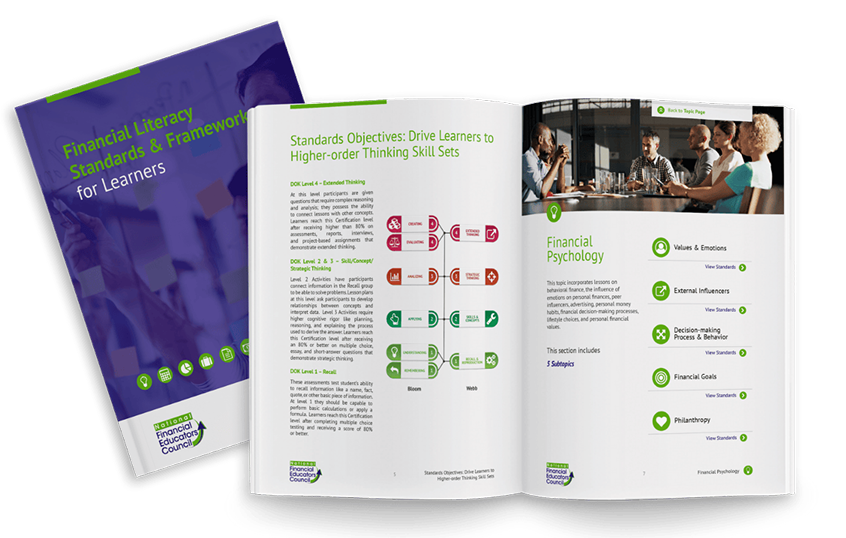
WAFEC supports the adoption of comprehensive learner outcome standards and educator competency frameworks to strengthen instructional quality statewide. By providing clear benchmarks for what students should know and be able to do – and what educators must demonstrate to teach effectively – WAFEC helps establish consistent expectations that support long-term financial capability development.

Closing Statement

Washington’s students deserve more than exposure to financial concepts; they deserve real preparation for the financial decisions that shape adulthood. These findings reveal a clear opportunity to strengthen financial education by aligning it with the rigor and accountability applied to other core subjects.

By advancing standards-based reform and investing in quality implementation, Washington can ensure that every student graduates financially prepared for life beyond high school. Meaningful progress requires collective action from educators, families, policymakers, and community leaders – working together to make financial education a foundational part of a future-ready education system.

National Financial Educators Council

OSPI Financial Education K-12 Standards (2016)

OSPI Financial Education Resources – FEPPP

Senate Bill 5080 – Financial Education Graduation Requirement proposal

Senate Bill 5849 – 2026 proposal

NFEC’s national and state advisory board

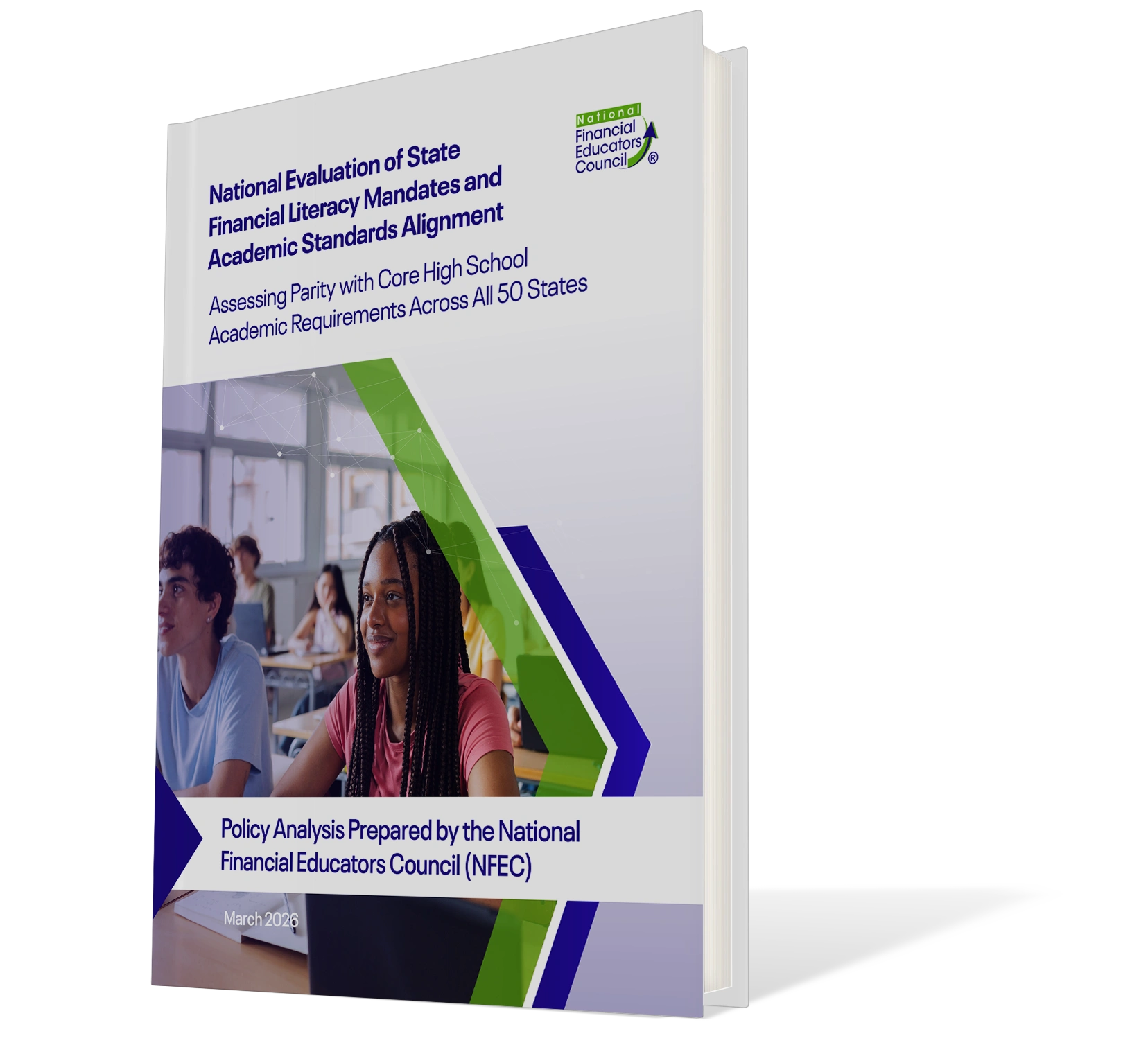
National Evaluation of State Financial Literacy Mandates and Academic Standards Alignment

State-Mandated Financial Literacy Standards: A Comprehensive National Review

Personal finance standards

Certified financial literacy professional

Teaching financial literacy to middle school

Financial Literacy Standards in Washington

As of 2026, Washington does not yet require a standalone personal finance course for high school graduation. Washington students must complete a total of 24 credits – including core subjects and elective/flexible credits – but financial literacy is not currently a required credit on its own. While the Office of Superintendent of Public Instruction (OSPI) has adopted financial education learning standards (spending and saving, credit and debt, employment and income, investing, risk management, and financial decision-making) that districts are encouraged to use, there is no statewide mandate that every student must complete personal finance coursework to earn a diploma. Source.

Pending financial literacy legislation in Washington includes Senate Bill 5080 (2025) and Senate Bill 5849 (2026), which were introduced to require students to meet state financial education standards as a graduation requirement beginning with future graduating classes, but none have been enacted as law as of late 2025. Source.

Past Reviews

It appears that, unfortunately, the Evergreen State needs to make important headway toward improving its standards for financial education in schools. According to the Center for Financial Literacy, Washington got an “F” for those guidelines in the 2015 issue of the National Report Card Champlain College compiles biannually. Washington has no requirement that students complete personal finance instruction in order to receive a high school diploma.

While Washington has economics criteria embedded in its 12th-grade social studies standards, no personal finance concepts are included. The Washington state legislature recently amended a law that requires the Superintendent of Education to integrate financial education, skills, and content knowledge into state learning benchmarks. Although the law has yet to be implemented, when it goes into effect it may improve Washington’s grade.

The state of Washington includes financial instruction in its K-12 standards mandated to be implemented at the district level, says the Economic Education Council. However, no high school course in personal finance must be offered or taken.

While all high schools in Washington are required to offer financial literacy education, it is not currently a mandatory requirement for graduation. However, legislative efforts are underway to change this. In January 2025, Senate Bill 5080 was pre-filed, proposing that financial education become a graduation requirement by the 2029-30 school year. If enacted, this bill would ensure that every student in Washington receives dedicated financial literacy instruction before graduating.

In 2015, the Legislature established the Financial Education Public-Private Partnership (FEPPP). FEPPP is composed of members of the Legislature, representatives from the private for-profit and nonprofit financial services sector, the Washington State Department of Financial Institutions, and OSPI, the State Treasurer, and teachers. FEPPP has a variety of responsibilities, including, among others: seeking out and determining the best methods of equipping students with the knowledge and skills they need to make critical decisions regarding their personal finances; developing and communicating financial education standards to school districts; reviewing financial education curriculum; and monitoring, creating, and providing guidance for professional development (PD) for educators.

Washington Treasury Request for Financial Education Legislation in Schools

Washington House Bill 1285 (2025)

Washington K–12 Financial Education Learning Standards

Washington Financial Education Standards Alignment Chart (Grades 9–12)

Washington Financial Education Public-Private Partnership (FEPPP)

Washington Final Bill Report for House Bill 5720